

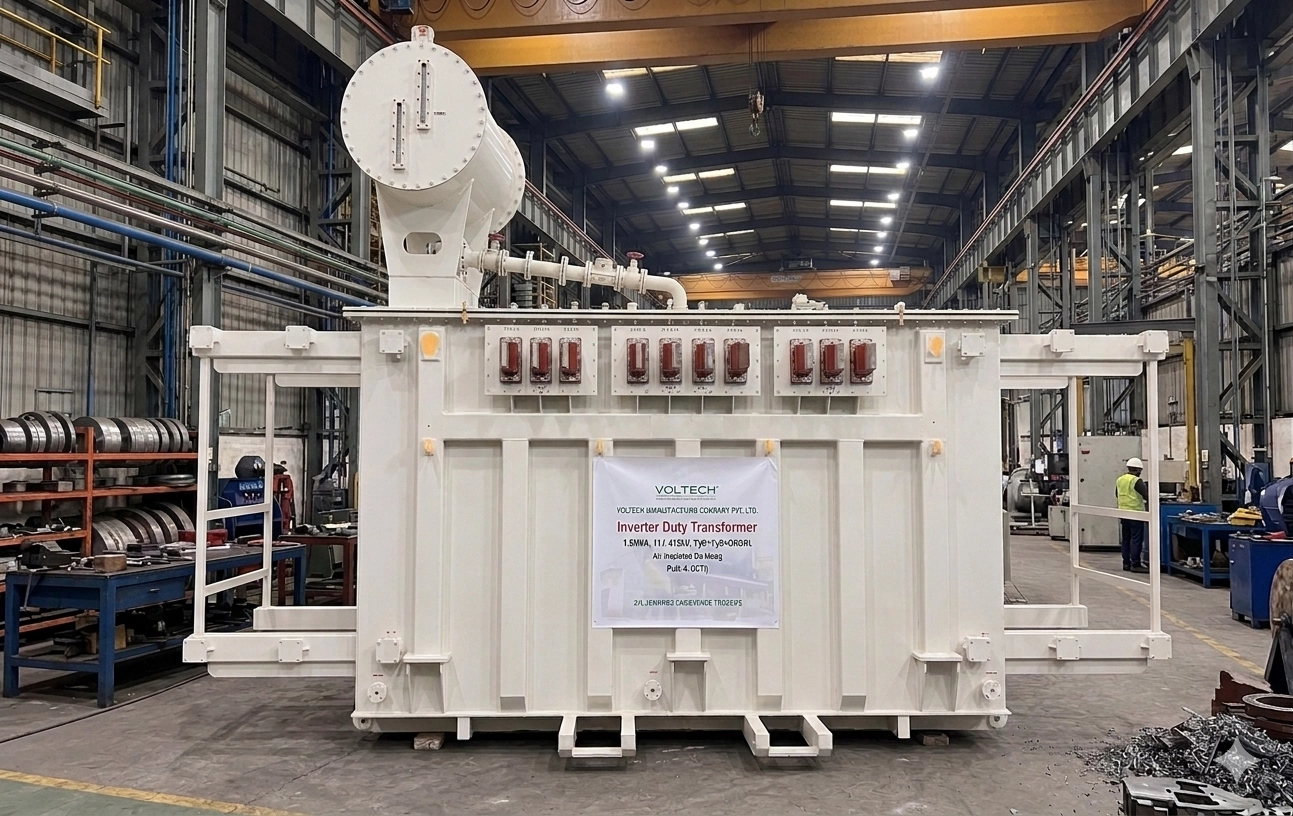
Why standard transformers fail in solar plants - and how Voltech's CPRI type-tested IDTs handle PWM harmonics, multi-inverter configurations and India's 500 GW renewable target.
- ●Voltech Manufacturing Company Pvt. Ltd. (VMCPL) designs and manufactures Inverter Duty Transformers up to 25 MVA, 110 kV class, from its facility in India.
- ●The reference design - 18 MVA, 33 kV / 4×660 V, 5-Winding IDT - has been successfully type-tested at CPRI Bangalore, making it bankable for SECI, NTPC and state nodal agency tenders.
- ●All IDTs are tested in a NABL-accredited in-house laboratory up to 33 kV, operating under the ILAC mutual recognition framework - ensuring test results are accepted globally.
- ●Every unit is compliant with IS:2026 / IEC 60076 / IEC 61378 / IEEE C57.159-2016 - the full dual framework mandated by Indian EPCs and international project lenders.
- ●IDTs are purpose-engineered for a THD design basis of ≥ 5%, with impedance as per applicable standard norm and OCTC tap changer providing ±5% voltage adjustment in 2.5% steps.
Introduction - The Solar EPC Core: Managing Technical Risk in India's 500 GW Turnkey Infrastructure
"India's solar energy sector has crossed 85 GW of installed capacity and is racing toward the government's ambitious 500 GW renewable energy target by 2030. Behind every megawatt-scale solar farm - between the inverter racks and the high-voltage grid - sits one mission-critical piece of equipment that most project developers underestimate: the Inverter Duty Transformer (IDT)."
Solar inverters produce Pulse Width Modulated (PWM) waveforms loaded with high-frequency harmonics that rapidly degrade standard transformers - an IDT is engineered to absorb these stresses while maintaining thermal and electrical stability for the full 25-year plant life.
What Is an Inverter Duty Transformer?
An Inverter Duty Transformer (IDT) is a highly specialised step-up power transformer engineered explicitly to interface between power electronic frequency converters and a medium-voltage electrical distribution network. While structural similarities exist with traditional distribution transformers, an IDT is specifically built to withstand the intense thermal and mechanical stresses imposed by Pulse Width Modulated (PWM) waveforms and high-frequency harmonic injection.
Key principle: Inverter Duty Transformers are designed and tested to handle a Total Harmonic Distortion (THD) of 5% or higher - in line with the actual harmonic profile generated by modern solar string and central inverters.
Why Solar Plants Demand Specialized IDTs
- Harmonic stress: IGBT-based solar inverters switch at 2-20 kHz, injecting 5th, 7th and 11th order harmonics that raise copper losses by 15-25% in standard transformers - accelerating insulation failure. IDT windings are sized to the actual harmonic spectrum at THD ≥ 5%.
- Multi-winding aggregation: A single IDT with 1, 2, 4 LV windings on one HV primary consolidates multiple inverter blocks into a single grid connection point, cutting transformer bays, civil costs and O&M complexity.
- DC component tolerance: Solar inverters inject a small DC offset (typically 0.5% of rated current) that saturates a standard transformer core. IDTs are designed to withstand this without efficiency loss or audible noise.
Key Technical Features of a Solar IDT
HI-B CRGO Core
HI-B grade silicon steel maintains 1.55 T flux density with low exciting current under non-sinusoidal loading.
Multi-Winding LV Design
1, 2, 4 LV windings on a single HV primary - proven in Voltech's 18 MVA, 5-winding IDT - consolidating multiple inverter blocks into one grid connection point.
Foil + Disc Winding
Foil LV windings minimise leakage inductance; disc HV windings provide surge robustness and short-circuit withstand strength.
Copper Shield Winding
A grounded copper shield winding between HV and LV eliminates EMI coupling from inverter switching noise.
Thermal Design at 50°C Ambient
Designed for a maximum ambient of 50°C (India-relevant) with top-oil rise ≤50°C and winding rise ≤55°C by resistance - giving hotspot winding temperature ≤98°C under continuous full load.
Over-Fluxing Tolerance
Continuous 110% over-fluxing capability handles morning ramp-ups and grid interconnection transients without core saturation.
India's Solar Growth & the IDT Market
- India's installed solar capacity grew from 28 GW in FY2019-20 to over 86 GW by FY2024-25 - a 25% CAGR making it the fastest-expanding major solar market globally, driven by accelerating state and central tenders, rooftop mandates and utility-scale parks exceeding 500 MW.
- Every gigawatt of that growth required a step-up transformer at each inverter-to-grid connection - Figure 2 tracks the capacity addition year by year.
Figure 2: India solar installed capacity (GW) - FY2019-20 to FY2024-25, with solar share of national grid (%). Source: MNRE / CEA Annual Reports.
- Every new solar megawatt requires an IDT - transformer demand scales directly with installed capacity, from 10 MW rooftop clusters to 500 MW+ ultramega parks.
- Utility-scale parks account for the majority of total MVA capacity deployed, pushing average transformer ratings higher with each successive tender cycle.
- Up to 5 MVA (38%): Rooftop solar and C&I installations - largest segment by unit count.
- 5-10 MVA (32%): Ground-mounted parks of 10-50 MW under state and central tenders.
- 10-20 MVA (22%): Fastest-growing by total MVA - multi-winding units reduce transformer bays and BOP costs on 100 MW+ parks. Above 20 MVA (8%) covers ultramega and offshore wind.
Figure 3: IDT deployment mix by MVA rating - Indian solar market, FY2025-26. Source: MNRE / Bridge to India Solar Compass 2026.
India's deployment mix reflects a domestic market maturing at pace. The same fundamentals - renewable energy mandates, industrial VFD adoption and grid modernisation - are now driving IDT demand across every major global region. Figure 4 ranks those markets by CAGR, highlighting where Indian manufacturers are most competitively positioned: high-ambient markets like Africa, the Middle East and South America, where Voltech's 50°C-rated designs hold a natural engineering advantage over alternatives built for temperate climates.
Global IDT Market CAGR by Region (2024–2030)
The global Inverter Duty Transformer market was valued at approximately USD 3.72 billion in 2024 and is projected to reach USD 6.28 billion by 2033, growing at a compound annual rate of 6.1%. This growth is not driven by a single geography - it reflects a structural convergence across every major industrial economy: the accelerating deployment of utility-scale renewable energy, the rapid adoption of variable frequency drives (VFDs) in industrial automation and the mandated modernisation of ageing grid infrastructure.
Unlike conventional distribution transformers, IDTs represent a higher-specification product category. Procurement cycles are longer, technical evaluation is more rigorous and type-test documentation from accredited facilities is increasingly required by development finance institutions and EPC contractors across regions. This raises the barrier to entry - and rewards manufacturers like Voltech that hold NABL accreditation and CPRI type-test certification across their IDT range.
The seven-region CAGR breakdown in Figure 4 reveals a market with pronounced growth differentials. The fastest-growing markets share a common characteristic: high ambient operating conditions between 40-55°C, where Indian transformer design standards hold a direct competitive advantage over alternatives built for temperate climates.
Figure 4: IDT market CAGR by region (2024-2030). Source: Growth Market Reports, Inverter Duty Transformer Market Report 2024-2030.
Africa leads at 7.5% CAGR - driven by sub-Saharan national electrification programmes, solar mini-grid rollout and industrial VFD adoption in Nigeria, Kenya and Ethiopia. South America (6.8%) reflects Brazil's wind and solar expansion alongside Chile and Argentina's lithium-sector demand. The Middle East (6.2%) is anchored by Saudi Vision 2030, UAE Net Zero 2050 and NEOM's infrastructure pipeline. Europe and UK (5.7%) and North America (5.4%) show steady, policy-led growth through the EU Green Deal and the US Inflation Reduction Act respectively. CIS countries trail at 4.5%, constrained by limited renewable energy mandates. Critically, the three highest-CAGR regions - Africa, South America and the Middle East - all operate at ambient temperatures between 40-55°C, aligning precisely with Voltech's 50°C thermal design standard.
African & Middle East Markets: Where Indian IDT Design Has a Natural Advantage
Voltech's IDTs are designed for a maximum ambient of 50°C - the same thermal ceiling that defines operating conditions across Sub-Saharan Africa and the Gulf. European alternatives engineered for 15-25°C ambient environments require de-rating or redesign for these markets, creating a direct competitive window for Indian manufacturers.
Illustrative Technical Specifications: Solar IDT Reference Design
The following table is based on the actual specifications of Voltech's 18 MVA, 33 kV / 4×660 V, 5-winding Inverter Duty Transformer - successfully type-tested at CPRI Bangalore - and reflects a reference design for large utility-scale solar applications.
Table 1: Technical specifications - Voltech 18 MVA, 33 kV / 4×660 V, 5-Winding Inverter Duty Transformer (successfully type-tested at CPRI Bangalore)
| Parameter | Specification | Solar Relevance |
|---|---|---|
| Rating | 18 MVA | Scales from rooftop to utility-scale |
| Voltage (HV / LV) | 33 kV / 0.660 × 4 windings | Direct 33 kV grid injection |
| No. of Windings | 5 (1 HV + 4 LV) | Aggregates 4 inverter blocks per transformer |
| Vector Group | YNd11d11d11d11 | Eliminates triplen harmonic circulation |
| Cooling | ONAN (Oil Natural, Air Natural) | Low maintenance; suitable for outdoor solar sites |
| Flux Density | 1.55 Tesla (HI-B CRGO core) | Low no-load losses; better efficiency at partial load |
| Current Density | 2 A/sq.mm (HV + LV) | Provides THD headroom ≥ 5% |
| No-Load Losses | ≤ 0.1% | Critical for nighttime standby losses in solar plants |
| Load Losses | ≤ 1% | Directly impacts plant efficiency and PR ratio |
| Impedance | As per applicable standard norm | Controls fault current and voltage regulation |
| Top Oil Rise | ≤ 50°C above 50°C ambient | Designed for hot Indian climate conditions |
| Winding Rise | ≤ 55°C (by resistance method) | Prevents premature insulation ageing |
| Tap Changer | OCTC: ±5% in 2.5% steps | Handles grid voltage variation at PCC |
| Applicable Standards | IS:2026 / IEC 60076 / IEEE C57.159-2016 | Meets SECI / NTPC / DISCOM requirements |
| Type Test | CPRI Bangalore certified | Accepted by all major project lenders and EPCs |
How to Select the Right IDT for Solar Plants
- Match inverter capacity: Group inverter blocks by available LV winding count (1, 2, 4 windings) - a single 18 MVA 5-winding IDT eliminates three additional transformer bays versus one-to-one pairing.
- Confirm grid voltage: HV winding must match the DISCOM interconnection requirement - 11kV, 22kV, 33kV for projects up to 100 MW; 110kV or 220kV above that.
- Get the harmonic spectrum: Request actual current harmonic data (% of fundamental) from the inverter OEM and provide it to the transformer manufacturer - this directly determines conductor sizing and rated load loss.
- Declare site ambient: Provide maximum site temperature and altitude to the manufacturer - high-ambient or high-altitude sites require thermal de-rating to keep hot-spot temperature below the 110°C IS:2026 threshold.
- Require type-test evidence: DFI-financed projects require transformer type test certificates from NABL-accredited labs - Voltech's 18 MVA IDT is CPRI-certified and bankable for SECI and NTPC tenders.
Applicable Standards for Solar Inverter Duty Transformers
Solar IDTs in India are governed by a dual framework of Indian Standards (IS) and internationally recognized IEC/IEEE standards. Compliance with both is typically mandated by EPCs and project lenders:
Table 2: Applicable Indian (IS) and international (IEC / IEEE) standards for solar Inverter Duty Transformers - dual compliance framework mandated by EPCs and project lenders
| Indian Standard (IS) | International Standard (IEC / IEEE) | Description |
|---|---|---|
| IS: 2026 | IEC 60076 | Power transformers - general requirements |
| IS: 2026-7 | IEC 60076-7 | Loading guide for oil-immersed power transformers |
| - | IEC 61378 | Converter transformers (inverter duty application) |
| - | IEEE C57.159-2016 | Guide on transformers for distributed photovoltaic (DPV) power generation systems |
| IS 335 | IEC 60296 | Insulating oils for transformers and switchgear |
| IS: 2099 | IEC 60137 | Bushings for alternating voltages above 1000 V |
| IS: 3639 | - | Fittings & accessories for power transformers |
| IS: 8478 | IEC-214 | Off-load tap changer - application guide |
| IS: 2705 | IEC 60185 | Current transformers |
| IS: 3347 | - | Dimensions for porcelain transformer bushings |
Frequently Asked Questions
Start Your Technical Consultation
To initiate a technical consultation for your EPC requirements, reach out to our team. We work with solar project developers, EPC contractors, industrial plant operators, utility-scale IPPs, and infrastructure lenders requiring CPRI-backed transformer documentation for financial due diligence.
[email protected]B.E. in Electrical & Electronics Engineering, Periyar University · MBA in Marketing, University of Madras · 20+ years specialising in custom transformer design, industrial power infrastructure and IEEE/IEC standards compliance.
Connect on LinkedIn